
Why High Electricity Prices Are Stifling Ireland’s Retrofit Revolution—and How We Fix It
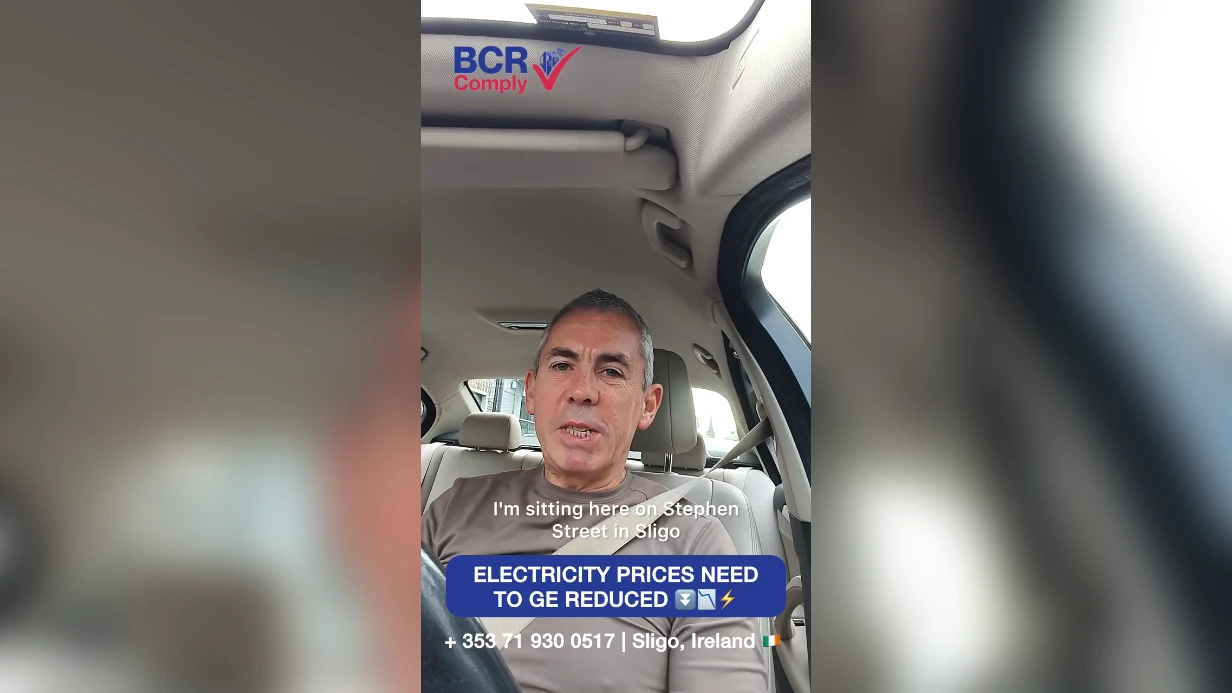
Ireland doesn’t need higher electricity prices—we need lower ones. Expensive energy does more than increase a household bill. It raises the cost of running an Irish business, puts pressure on competitiveness and makes it harder for property owners to commit to an energy upgrade.
A commitment to the whole retrofit journey
In our original discussion, a traffic blockage on Steven Street in Sligo prompted a reflection on a much bigger obstacle: the economics holding back Ireland’s energy transition. Our advocacy for heat pumps is part of a broader commitment to making retrofit easier to deliver at scale, not a claim that one technology is the answer for every building.
Insulation, ventilation, appropriate heating systems, solar PV and well-managed installation all have a role. But even a technically strong proposal becomes harder to justify when the electricity needed to run it is expensive. Affordable energy should be part of the retrofit conversation, alongside grants, installation quality and building suitability.
Energy affordability is a competitiveness issue
Our message points to countries such as Lithuania, Latvia and Poland as prompts for asking what Ireland can learn from other electricity markets. A meaningful price comparison must use the same reporting period, consumption band and treatment of taxes, subsidies and standing charges. Household and business tariffs are not interchangeable, and a national average is not a quote for an individual customer.
For that reason, we are not presenting the indicative country-by-country unit rates discussed in the original commentary as verified August 2026 tariffs. The policy argument remains clear: lowering energy costs would ease pressure on households and businesses and strengthen the financial case for electrification. Ireland should pursue that outcome rather than accept higher bills as inevitable.
How wholesale pricing influences the bill
The European Commission describes the wholesale electricity market as a marginal, or “pay-as-clear”, system. Offers are accepted to meet demand, and the last accepted offer sets the clearing price for that trading period. Gas-fired generation can therefore influence the price even when lower-marginal-cost renewable electricity is also available. See the Commission’s explanation of electricity market design.
Our “taxi rank” analogy illustrates the concern: imagine eight standard taxis offering a journey for €20 and two limousines asking €200. If the service used a single clearing price and demand required a limousine, that higher price would apply to the accepted journeys. These are illustrative figures, not electricity-price data.
The analogy has limits. A wholesale clearing price is not the entire retail bill, and generators’ final revenues can also be affected by contracts and support schemes. Network charges, supplier purchasing arrangements, taxes and other costs matter too. It would be misleading to say that every unit on a household bill is simply priced at the cost of gas, or that changing the auction mechanism alone guarantees cheaper power.
Reform should bring renewable benefits to consumers
BCR Comply’s position is that consumers should benefit more directly from lower-cost renewable generation and be less exposed to fossil-fuel price volatility. We support examining how market arrangements can achieve that while retaining reliable supply and investment in new capacity.
This is not a reform starting from scratch. The EU’s revised electricity market design rules entered into force on 16 July 2024. The Commission identifies long-term power purchase agreements and two-way contracts for difference as tools to make bills less dependent on short-term prices. These measures are distinct from simply paying each generator its stated production cost.
Ireland’s wind resources offer an important opportunity, but generation must be matched by grid connections, storage, flexibility and delivery of the supporting infrastructure. Our call is for those investments and market reforms to translate into affordable, dependable electricity—not just more installed capacity.
Heat pumps: efficiency needs affordable electricity
Heat pumps move heat from the air, ground or water into a building rather than producing all their heat through combustion. SEAI’s Heat Pumps Technology Guide (August 2020) describes achievable efficiencies of 250% to 400%, equivalent to roughly 2.5 to 4 units of heat per unit of electricity under suitable conditions. That guide focuses on non-domestic systems and notes that much of its guidance also applies to smaller systems.
Those figures are not a guaranteed result for every home or every day of the year. Building heat loss, outdoor conditions, heating flow temperatures, system sizing, controls, installation and maintenance affect real-world performance. Annual seasonal performance is more useful for estimating running costs than a single favourable operating point.
The cost comparison also depends on the electricity tariff, the alternative fuel price and the efficiency of the existing boiler. A heat pump’s approximate electricity cost per unit of useful heat is the electricity unit price divided by its seasonal performance factor. Higher electricity prices can erode its running-cost advantage; they do not mean every heat pump costs the same as an oil or gas boiler. Carbon savings likewise depend on system performance and the electricity supplying it.
Solar PV can help—but it is not a complete substitute
Solar PV can reduce purchased electricity where a building uses its own generation. Pairing it with a heat pump may support a wider retrofit strategy, but winter heating demand and daylight generation do not always coincide. Expected savings should account for the property’s demand profile, system size, controls and any storage, rather than assume that solar will cover all heating needs.
Lower costs, better delivery, stronger confidence
To accelerate retrofit, Ireland needs both well-designed building upgrades and an energy market that makes electrification attractive. BCR Comply advocates lower electricity costs, practical reform and high-quality delivery so that households and businesses can make informed decisions with greater confidence.
Our message is simple: bring energy costs down, not up. Better affordability would support Irish competitiveness and help more property owners move from considering a retrofit to completing one.
Get in touch
Talk to BCR Comply about managing your retrofit projects and compliance workflow. Email sales@bcrcomply.com or call 071 930 0517. You can find us on Holborn Street, Sligo, Ireland.
See BCR Comply in action
Discover how the first and only all-in-one CRM, project management and QMS platform for retrofit and solar can work for your business.