
Navigating the SEAI Windows & Doors Grant: An End-to-End Guide for Homeowners and Installers
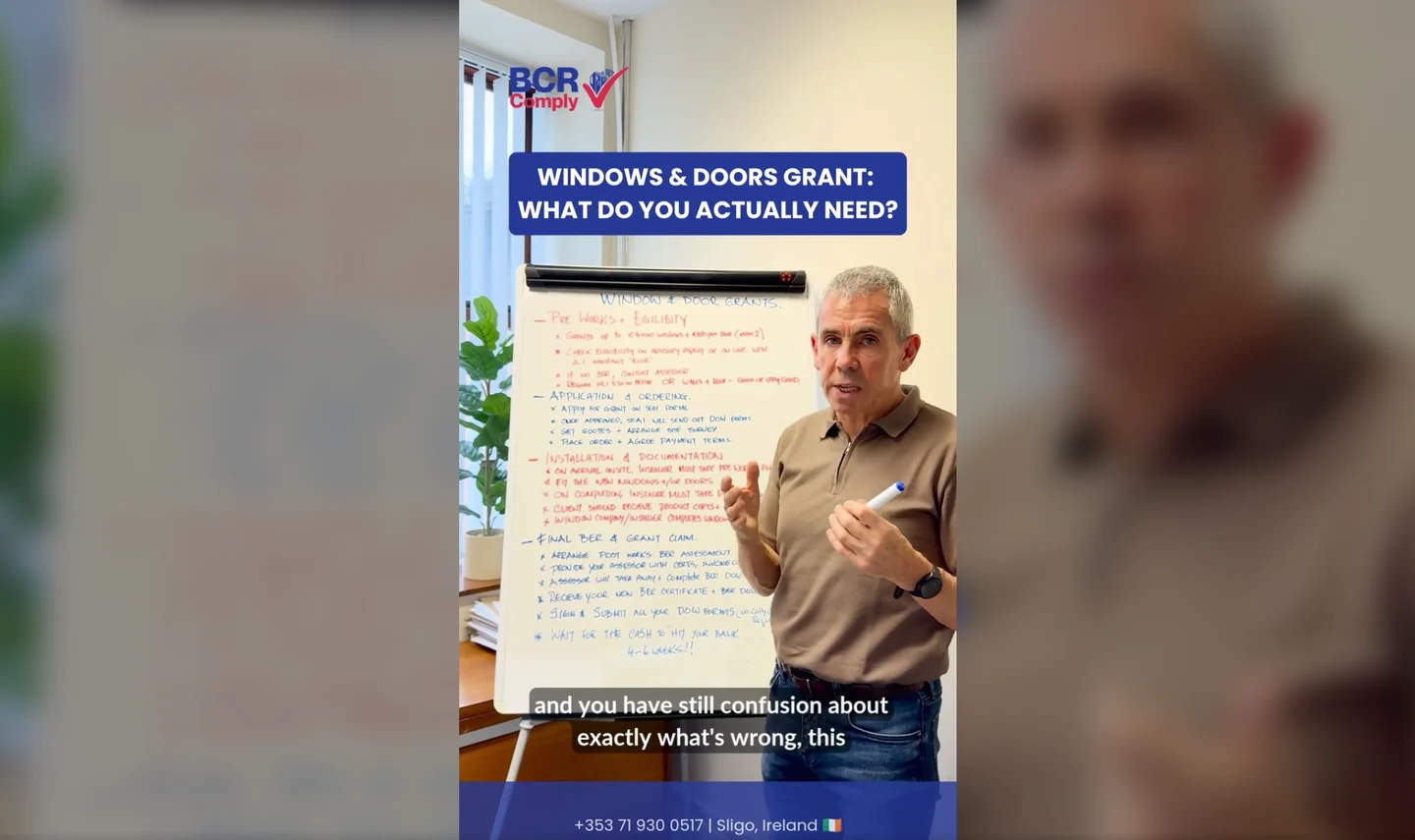
Better windows and doors can improve comfort and reduce heat loss. But a successful upgrade needs more than a product choice: homeowners and installers also need to understand the grant pathway, technical requirements and records required for the final claim.
This guide focuses on SEAI’s individual windows and doors grant for homes. It is not a commercial-building grant guide or a substitute for SEAI’s terms and your grant offer. SEAI’s 20 February 2026 announcement introduced standalone support, with applications opening on 2 March 2026. Always check the official grant page for the requirements applying to your project.
1. Check the home and the grant pathway
SEAI states that the home must have been built and occupied before 2011 and have suitable attic and wall insulation. Check the property’s BER Advisory Report and previous insulation upgrades; a BER assessor can advise where the evidence is unclear or further improvements are needed. Have the property’s MPRN available.
You can apply for windows, external doors, or both. SEAI says you do not have to replace every window, although the grant can only be paid once per property and the applicable post-works performance requirements still need to be met. Do not assume that a glazing repair alone qualifies: agree the eligible replacement scope with your registered contractor and SEAI before committing to it.
For a self-managed application, you arrange the work with an SEAI-registered contractor and claim payment after completion. SEAI also describes a managed route through a registered One Stop Shop. Confirm the particular scheme and application route rather than mixing this individual grant with the requirements for a wider whole-home upgrade.
2. Apply and confirm approval before starting
Get quotes from registered contractors, agree the proposed work and submit your application. SEAI’s standard sequence is to receive a grant offer before commencing works. Read the offer’s conditions and completion deadline, and confirm the position before placing orders or paying deposits.
There is an important qualification to blanket advice about earlier orders: SEAI’s published guidance describes transitional eligibility for some upgrades ordered or commenced since the government announcement on 27 January 2026, subject to scheme requirements and registered contractors. This is not general permission to start before approval. If it affects your project, seek confirmation from SEAI or your registered contractor rather than assuming either eligibility or automatic disqualification.
3. Install to the required performance and safety standards
SEAI’s grant payment criteria specify a U-value of 1.4 W/m²K or lower for new windows and doors, confirmed on the declaration of works signed by the contractor and homeowner. A lower U-value indicates less heat loss. Ask for evidence covering the installed unit, not just a headline glazing specification, and check the current technical requirements for the proposed products.
Performance is not the only consideration. Ventilation, emergency escape requirements and window restrictors where required must also be addressed. Reducing draughts must not compromise healthy indoor air or the ventilation needed for an open-flued appliance. The contractor should explain how these requirements are being met.
4. Keep a clear documentation record
Agree who will collect each required document before installation begins. Keep the grant offer, agreed scope, product performance information, invoices, completed declaration of works and BER information together. Dated before-and-after photographs can provide useful supporting evidence; confirm the specific evidence required for your claim rather than treating a generic photo list as an official rule.
Homeowners should check application details, arrange access and retain the offer and payment records. Installers should confirm registration for the relevant work, supply compliant products, complete the necessary declarations and provide the supporting technical records. Clear responsibilities help prevent missing information without guaranteeing approval or a particular processing time.
5. Arrange the final BER and submit the claim
A post-works BER is required. SEAI’s payment criteria state a Heat Loss Indicator of 2.3 W/(K·m²) or lower, or attic and walls rated “Good” or “Very Good”, as recorded in the post-works BER Advisory Report. Ask your assessor to confirm how the property meets the applicable criteria.
Submit the required documents through the process specified by SEAI and respond to any requests for clarification. An inspection may apply. Payment depends on compliance and processing: there is no guaranteed 10–14-day payout or fixed number of weeks saved by using a checklist.
Fabric improvements as part of a wider retrofit
Well-designed window and door upgrades can reduce heat loss and improve comfort, especially alongside suitable insulation and ventilation. They do not automatically eliminate thermal bridging or guarantee a particular bill saving.
A lower heating demand can support an efficient heat pump installation, but replacing every window is not a universal prerequisite. Building heat loss, system design, operating temperatures and seasonal performance all matter. Consider the building as a whole rather than promising a fixed heat output or running-cost advantage from one measure.
Use a checklist to organise the work
BCR Comply supports retrofit teams with project records and compliance workflows. Our Windows & Doors Grant Checklist can help organise the stages, responsibilities and supporting documents, but it does not replace official guidance or guarantee that SEAI will approve a claim.
To request the checklist, send us a message or comment “Checklist” on our social channels, or contact the team directly.
Get in touch
Talk to BCR Comply about organising your retrofit projects and compliance records. Call 071 930 0517, email sales@bcrcomply.com, or find us on Holborn Street, Sligo, Ireland.
See BCR Comply in action
Discover how the first and only all-in-one CRM, project management and QMS platform for retrofit and solar can work for your business.