
Can Ireland Lower Its Electricity Costs? Deconstructing Market Mechanics, Retrofits, and the Path to Affordable Energy
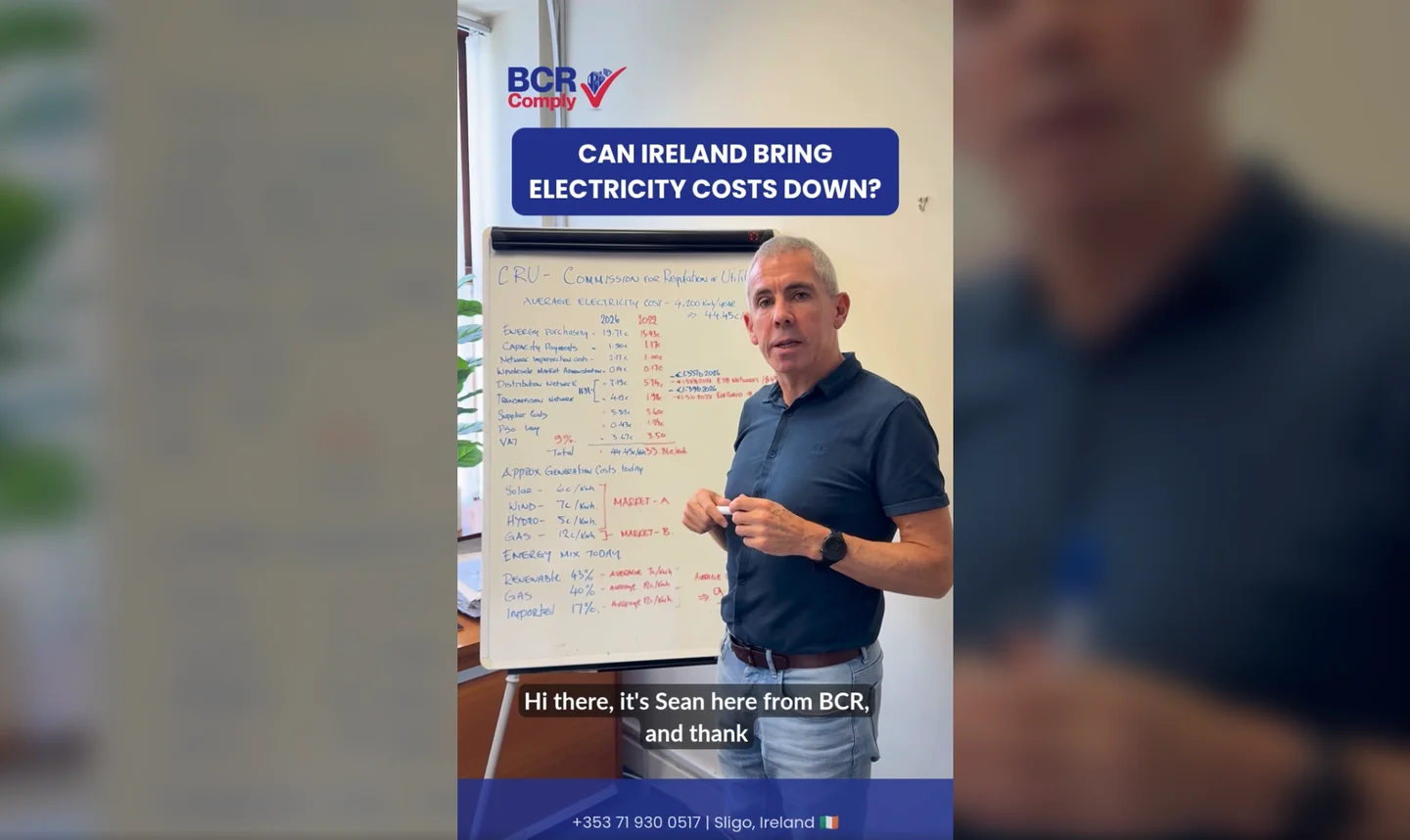
Ireland needs affordable electricity to support both everyday life and the transition to better buildings. High bills put pressure on household budgets, business competitiveness and the decision to invest in a retrofit. At BCR Comply, our advocacy is about enabling energy upgrades at scale—not promoting a single technology regardless of its suitability.
The cover is a still from Sean’s discussion. Figures visible on the flipchart are not a verified September 2026 tariff comparison; the discussion below sets out the qualifications needed to assess costs fairly.
1. High electricity costs: compare like with like
There is a documented affordability concern. Eurostat’s release of 6 May 2025 placed Ireland among the higher-priced EU household electricity markets for the second half of 2024. That is historical context, not a quotation for September 2026 or a claim about every customer’s bill.
Comparisons with the UK, Latvia, Lithuania, Poland or Iceland need the same reporting period, consumption band, currency basis and treatment of VAT, taxes, subsidies and standing charges. Household averages must not be mixed with business tariffs. Without a verified like-for-like September 2026 dataset, we do not reproduce a numerical country tariff table.
Our position is that affordable running costs should sit alongside grants, installation quality and building suitability in retrofit policy. High electricity prices can weaken the financial case for electrification, but they are not the only factor determining whether an upgrade makes sense.
2. Wholesale pricing and the taxi-rank analogy
In a marginal, or “pay-as-clear”, wholesale auction, offers are accepted to meet demand and the marginal accepted offer sets the clearing price for the relevant trading period and market area. Gas-fired generation can influence that price when it is needed, but gas does not always set it. Available generation, demand, interconnection and system conditions all matter.
Imagine a taxi rank with eight standard taxis offering a journey for €20 and two limousines offering it for €200. In a hypothetical single-price auction, if demand requires a limousine, the accepted journeys would clear at €200. If the standard taxis meet demand, that higher offer need not set the price. These are illustrative taxi prices, not electricity data.
The analogy explains a clearing-price mechanism, not the whole electricity system. Day-ahead, intraday and balancing markets have distinct roles. A generator’s wholesale settlement is not necessarily its final revenue: hedging, power purchase agreements and support arrangements can change what it ultimately receives. It would be wrong to say that every renewable generator always earns the gas price.
Retail tariffs are different again. Suppliers’ purchasing and hedging, network charges, taxes, levies and other supply costs affect bills and the timing of price changes. Marginal pricing does not remove all competition: generators compete to be accepted and suppliers compete for customers. Wind and solar have low operating costs, but their investment, financing and system-integration costs still need to be funded.
3. Reform and lessons from other countries
BCR Comply advocates reforms that make the benefits of clean generation more accessible to consumers and reduce exposure to volatile fossil-fuel prices. That is a policy objective, not a guarantee that replacing one auction rule will automatically lower everyone’s bill. Simply paying each bid can change bidding behaviour rather than ensure bids equal production costs.
Reform is already under way. The European Commission’s electricity market design guidance explains the revised EU rules that entered into force on 16 July 2024. Long-term power purchase agreements and two-way contracts for difference aim to make bills less dependent on short-term prices. Their outcomes depend on implementation, contract design and how benefits and risks reach consumers.
Ireland’s wind resources, including offshore wind, offer opportunities. Realising them requires investment in grid connections, storage, flexibility and reliable supporting infrastructure, alongside planning and environmental safeguards. More renewable capacity alone does not guarantee a particular retail tariff.
Norway and Iceland offer lessons, not directly transferable price promises. Norway is not an island nation. The Norwegian Ministry of Energy’s overview, describing the system at the beginning of 2025, highlights hydropower, reservoirs and cross-border integration. The Government of Iceland’s energy overview describes hydro and geothermal generation using historical data, including 2015 electricity figures. Neither establishes a current September 2026 generation share or tariff for this article.
Different resources, weather, networks, demand profiles and policy choices limit direct comparisons. The useful lesson is to develop Ireland’s own resources effectively—not to assume it can reproduce another country’s electricity price.
4. Heat pumps, solar and practical retrofit delivery
A heat pump moves heat from the air, ground or water into a building. Under suitable conditions, it can deliver 3.5–4 units of useful heat for each unit of electricity. This is possible performance, not a guaranteed seasonal result. SEAI’s Heat Pumps Technology Guide (August 2020) explains the distinction between coefficient of performance at specified conditions and performance over a full year. The guide focuses on non-domestic systems, with much of its guidance also applicable to smaller installations.
For a realistic assessment, consider the property’s heat loss, insulation, ventilation, heat emitters, flow temperatures, installation quality, controls and maintenance. Seasonal efficiency should include the relevant auxiliary electricity use. Running costs depend on the actual electricity tariff and the alternative fuel price and boiler efficiency—not simply a headline efficiency figure.
A useful starting point is electricity unit price divided by seasonal performance factor to estimate electricity cost per unit of useful heat. A complete comparison also includes standing charges where relevant, installation and finance costs, grants and maintenance. Carbon benefits depend on system performance and the electricity supply; lower emissions and lower bills are related but distinct outcomes.
Solar PV can complement a heat pump by reducing purchased electricity when generation and demand coincide. It does not guarantee winter self-sufficiency: heating demand is often greatest when solar output is lower. System sizing, usage patterns, controls, storage and export arrangements all affect the result.
5. Affordable energy and well-managed projects
Lower and more predictable electricity costs can strengthen the case for retrofit. BCR Comply supports practical market reform, investment in clean energy and high-quality project delivery so that households and businesses can make informed choices. The aim is to make electrification attractive while maintaining a reliable system—not to promise savings that every property will achieve.
For software, project management and compliance support for your retrofit or solar business, get in touch with BCR Comply. We can discuss how to organise project information, documentation and team workflows; our platform does not guarantee energy savings or replace a property-specific technical assessment.
Call 071 930 0517 or email sales@bcrcomply.com. Find us at Holborn Street, Sligo, Ireland.
See BCR Comply in action
Discover how the first and only all-in-one CRM, project management and QMS platform for retrofit and solar can work for your business.